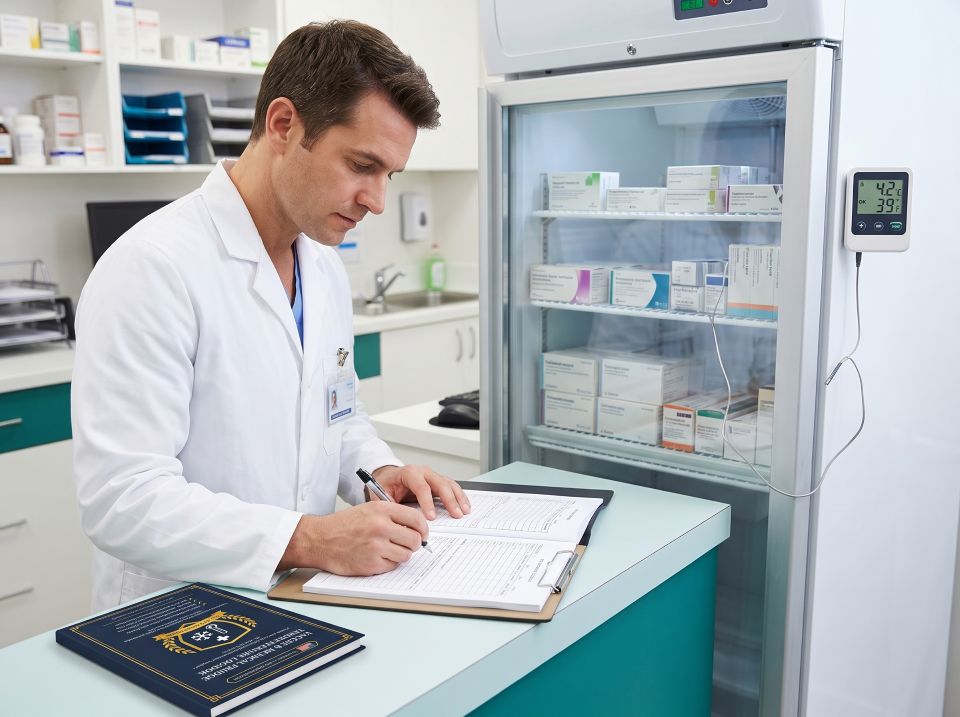
Under US immunization guidelines, maintaining an accurate CDC VFC temperature log is a mandatory duty for every healthcare facility. Specifically, the CDC Vaccine Storage and Handling Toolkit requires twice-daily temperature monitoring for all refrigerated and frozen vaccines. When a state VFC inspector arrives for a compliance visit, verbal assurances are never enough. Instead, clinics must present a bound paper trail proving continuous cold-chain integrity.
Furthermore, disciplined cold-chain tracking prevents thousands of dollars in spoiled vaccine inventory and protects patients from ineffective doses. Here is the complete compliance framework every US medical clinic, pediatric practice, pharmacy, and hospital must follow.
Refrigerated Vaccines (Fridge)
2°C to 8°C (36°F to 46°F)
Aim for an ideal midpoint of 5°C (40°F). Exposure below 2°C freezes adjuvanted vaccines and permanently destroys potency.
Frozen Vaccines (Freezer)
-50°C to -15°C (-58°F to +5°F)
Required for Varicella and MMRV vaccines. Any reading warmer than -15°C (+5°F) triggers an immediate temperature excursion.
1. Twice-Daily Min/Max Monitoring & Digital Data Logger (DDL) Rules
Checking a standard dial thermometer once a day fails state immunization audits. Because refrigerator temperatures fluctuate overnight, inspectors require continuous monitoring with a calibrated Digital Data Logger (DDL). Consequently, your daily cold-chain log must capture four essential elements:
- AM and PM Temperature Checks: Staff must read and record unit temperatures twice every workday. Specifically, check the unit at clinic opening and again before closing.
- Current, Minimum, and Maximum Readings: Logging only the current temperature is a common audit violation. Instead, staff must record the Min and Max extremes reached since the last reset.
- Buffered Probe & NIST Calibration: CDC VFC rules mandate a DDL equipped with a detachable glycol-encased probe. Moreover, each device requires a valid Certificate of Traceability and Calibration.
- Staff Initials & Exact Time Stamps: Every temperature entry must include the exact time of inspection and the initials of the responsible staff member.
Audit Standard: Example of a Compliant Twice-Daily CDC VFC Temperature Entry
| Day / Shift | Time | Current Temp | Min Temp | Max Temp | In Range? | DDL Reset? | Staff Init. |
|---|---|---|---|---|---|---|---|
| Mon — AM | 08:00 | 4.8°C | 4.2°C | 5.3°C | Yes | Yes | S.K. |
| Mon — PM | 17:15 | 5.1°C | 4.5°C | 5.8°C | Yes | Yes | A.R. |
Need a bound, multi-year register formatted around these exact CDC cold-chain grids? View the Vaccine & Medical Fridge Temperature Logbook on Amazon.com →
2. Mandatory Temperature Excursion Response Protocol
Whenever a fridge or freezer reading falls outside the approved CDC range, an immediate temperature excursion occurs. Failing to document your clinic’s response can force the disposal of your entire vaccine supply. Therefore, staff must execute four steps immediately:
- Quarantine and Label “DO NOT USE”: Keep affected vaccines inside a functioning storage unit at proper temperatures. Clearly label the doses so staff do not administer them before viability is confirmed.
- Record Excursion Details: Document the exact date, time, room temperature, and the unit’s minimum and maximum temperatures. Additionally, download the DDL data file to determine the total duration outside range.
- Contact Manufacturers or VFC Coordinators: Call the vaccine manufacturers or your state immunization program for stability guidance. Never discard exposed vaccines before receiving official viability instructions.
- Log Final Disposition & Corrective Action: Record the case reference number, the manufacturer’s determination, and any mechanical repairs made to the refrigerator.
3. DDL Calibration Tracking & 3-Year VFC Record Retention
State immunization auditors review historical archives alongside current monthly temperature sheets. To pass inspection without administrative citations, enforce three documentation rules across your facility:
- Minimum 3-Year Archive Retention: Federal VFC guidelines require clinics to retain temperature logs and DDL files for at least three years. However, some state health departments enforce even longer retention periods.
- Calibration Expiration Monitoring: Track the serial number and recalibration due date for every primary and backup DDL probe. Using an expired calibration certificate invalidates your entire temperature log.
- No-Erasure Correction Standard: Never use correction fluid on clinical cold-chain records. Instead, draw a single line through any clerical error, write the accurate figure, and add your initials.
4. Integrated Clinic Compliance: Controlled Substances & Cold-Chain
Many medical, pediatric, and veterinary clinics audited for vaccine cold-chain compliance also store scheduled medications on-site. For example, practices managing narcotics must maintain a separate 21 CFR 1304 logbook for DEA inventory and dispensing accountability. Keeping bound registers for both storage areas ensures complete audit readiness across your entire facility.
Why Loose Clipboard Sheets Put Your Vaccine Inventory at Risk
Loose monthly printouts taped to refrigerator doors frequently go missing during shift changes or lack dedicated fields for Min/Max extremes and excursion case numbers. When an audit gap occurs, state VFC programs can require clinics to replace spoiled or undocumented vaccine stock at their own expense. By contrast, a bound multi-year register keeps every AM/PM reading, DDL calibration record, and excursion report permanently organized in one audit-ready volume.
Protect Your Vaccine Inventory & Pass Every VFC Inspection
Do not risk vaccine spoilage or VFC compliance citations over missing fridge door sheets. Equip your clinical staff with a bound Vaccine & Medical Fridge Temperature Logbook engineered around CDC cold-chain, Min/Max DDL, and excursion reporting standards.
Order on Amazon.com (Prime Delivery) → Explore Our Full Compliance Catalog →