Across the United States and Canada, municipal, state, and provincial health departments enforce strict statutory oversight over public swimming pools, hotel spas, fitness clubs, resorts, and HOA aquatic facilities. Under the CDC Model Aquatic Health Code (MAHC), regional public health acts, and the federal Virginia Graeme Baker (VGB) Pool & Spa Safety Act, verbal assurances from maintenance staff never satisfy an inspector. Instead, facility operators must maintain a chronological, tamper-evident commercial pool water testing logbook proving continuous water sanitation, chemical balance, and mechanical safety.
Beyond preventing costly fines or mandatory facility closures, consistent water testing protects bathers from Recreational Water Illnesses (RWIs) such as Cryptosporidium, Legionella, and Pseudomonas, while shielding facility owners from severe legal liability. Here is the complete regulatory compliance framework every aquatic manager and Certified Pool & Spa Operator (CPO) must enforce.
Quick Reference: Critical Aquatic Parameters & Immediate Closure Triggers
Under standard US (MAHC) and Canadian health codes, any reading outside these statutory thresholds requires immediate bather evacuation and documented corrective action before reopening:
| Water / Safety Parameter | Ideal Operating Target | Mandatory Closure Trigger |
|---|---|---|
| Free Chlorine (Pool / Spa) | 2.0 – 4.0 ppm (Pool) | 3.0 – 5.0 ppm (Spa) | < 1.0 ppm (Pool) or < 2.0 ppm (Spa) / > 10.0 ppm |
| Combined Chlorine (Chloramines) | 0.0 – 0.2 ppm | > 0.4 ppm (Requires breakpoint chlorination) |
| pH Level | 7.2 – 7.6 (Optimal: 7.4) | Below 7.0 or Above 7.8 |
| Spa / Hot Tub Temperature | 100°F – 102°F (37.8°C – 38.9°C) | Exceeds 104°F (40°C) — Hyperthermia Hazard |
| Main Drain Cover (VGB Act) | Intact, ANSI/APSP-16 compliant, unexpired | Loose, cracked, missing, or expired drain grate |
1. Why Testing Water Once a Day Fails Health Inspections (The 3x-Daily Protocol)
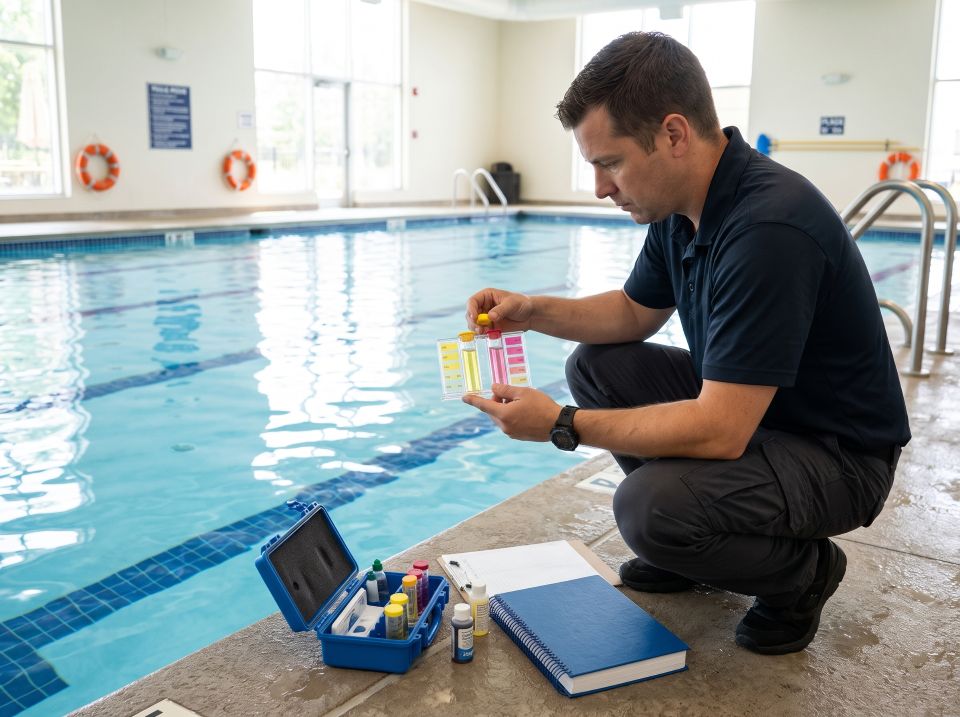
In commercial swimming pools and heated spas, water chemistry is never static. High bather loads, perspiration, sunscreen, UV exposure, and warm water rapidly deplete free chlorine and push pH out of range. Consequently, most North American health codes mandate manual DPD reagent testing—even when automated ORP/pH controllers are installed—across three structured checkpoints every operating day:
- Pre-Opening Baseline Verification: Before the first swimmer enters the water, operators must test and log Free Chlorine (or Bromine), Combined Chlorine, pH, water clarity (confirming the main drain is clearly visible from the deck), and water temperature.
- Mid-Day Peak Bather Load Check: During peak afternoon occupancy, staff must verify that sanitizer residuals have not dropped below statutory minimums and document any chemical additions (sodium hypochlorite, muriatic acid, or sodium bicarbonate) alongside the exact dosage applied.
- Evening Closing & Weekly Saturation Balance: At closing, final sanitizer and pH readings are recorded alongside weekly checks for Total Alkalinity (80–120 ppm), Calcium Hardness (200–400 ppm), Cyanuric Acid (stabilizer, restricted or banned in indoor pools and spas in many jurisdictions), and the Langelier Saturation Index (LSI).
Audit Standard: Example of a Compliant 3x-Daily Water Chemistry Log Entry
| Shift / Time | Free Cl / Br | Comb. Cl | pH | Temp (°F/°C) | Clarity & VGB | Chemical Dosing / Action | Operator Init. |
|---|---|---|---|---|---|---|---|
| Open 06:30 | 3.2 ppm | 0.0 ppm | 7.4 | 82°F | Clear / OK | No adjustment needed | M.T. |
| Peak 14:00 | 1.8 ppm | 0.2 ppm | 7.7 | 84°F | Clear / OK | Added 16 oz Muriatic Acid + Cl | M.T. |
Need a pre-formatted, inspection-ready register built around these exact parameters? View the Commercial Pool, Spa & Hot Tub Water Testing Logbook on Amazon.com →
2. Mechanical Room & Deck Safety Audits: Backwash Cycles, Flow Rates & VGB Compliance
Balanced water chemistry is only half of an official aquatic inspection. Environmental Health Officers routinely walk the pump room and pool deck to verify circulation turnover rates and federal entrapment-prevention compliance:
- Filter Pressure Differential & Backwash Logs: Operators must record influent and effluent pressure gauges (PSI) daily, verify flow meter readings (GPM) against the venue’s mandatory turnover rate, and log every sand, DE, or cartridge filter backwash cycle.
- Daily VGB Anti-Entrapment Drain Verification: Under the federal Virginia Graeme Baker Act, facilities must perform and document daily visual checks confirming that all submerged suction outlet covers, equalizer lines, and safety vacuum release systems (SVRS) are intact, firmly fastened, and within their stamped manufacturer service life.
- Deck Lifesaving & Emergency Equipment Audits: Daily records must confirm that reaching poles (shepherd’s hooks), ring buoys with throw lines, spine boards, emergency pump shut-off switches, and first-aid kits remain unobstructed and operational.
3. CDC Fecal, Vomit & Blood Contamination Incident Protocols
When a bodily fluid contamination event occurs in a commercial pool or spa, health inspectors require strict written proof that staff executed CDC Healthy Swimming hyperchlorination CT (Concentration × Time) disinfection standards before allowing bathers back into the water:
- Formed Stool vs. Diarrheal Incident Differentiation: Facilities must log the exact time of pool closure, physical removal of contaminants, filtration adjustments, and whether standard 2.0 ppm (25-minute) or Cryptosporidium-grade 20 ppm (12.75-hour) hyperchlorination was executed.
- Pre-Reopening Verification Sign-Off: Before reopening the vessel, operators must document the post-shock chlorine reduction and pH rebalancing readings, signed off by the certified operator or facility supervisor.
4. Record Retention & Audit-Proof Documentation Standards
Even facilities with crystal-clear water receive citations during health department audits if their record-keeping fails basic legal scrutiny. To protect your facility during unannounced inspections or liability claims, enforce four documentation rules across every shift:
- On-Site Statutory Archive Retention: Most US states and Canadian provinces mandate keeping daily water chemistry, backwash, and incident logs readily accessible on-site for at least 1 to 3 years.
- No-Erasure, Black-Ink Protocol: Never use correction fluid or tear pages out of a compliance logbook. Cross out clerical errors with a single line, write the corrected value beside it, and add initials and the date.
- Mandatory Corrective Action & Retest Entries: Recording an out-of-range reading (such as pH 7.9 or Free Chlorine 0.6 ppm) without documenting the chemical dosage added and the follow-up retest reading is cited by inspectors as an unresolved violation.
- Eliminate Loose Clipboard Sheets: Single pages on clipboards routinely get water-damaged on the pool deck, misfiled, or lost between shifts, creating unexplained gaps in your compliance timeline.
❌ Loose Clipboards & Blank Spreadsheets
Single sheets get soaked by pool deck splash, blow away, or lack dedicated columns for VGB drain checks, backwash PSI, and CDC fecal contamination CT logs—leading to avoidable health code violations.
✅ Bound Statutory Compliance Logbook
Keeps every 3x-daily chemistry test, chemical dosing adjustment, VGB drain check, backwash cycle, and CDC incident record bound in chronological order for immediate health inspector verification.
Ready to Make Your Facility Audit-Proof?
Do not risk a health department citation or forced closure over missing clipboard sheets. Equip your operators with a dedicated, bound Commercial Pool, Spa & Hot Tub Water Testing Logbook engineered around CDC MAHC, CPO, and VGB compliance standards for US and Canadian facilities.
Order on Amazon.com (Prime Delivery) → Explore Our Compliance Library →